

Seafood quality control and inspection decides whether chilled and frozen fish, shrimp, and shellfish clear a Saudi port or are refused entry, because exporters shipping into the Kingdom work within a document-driven food import system, so this guide breaks down the measurable parameters, the inspection sequence, the SFDA requirements behind every clearance, and the cold chain controls that protect product safety and quality from harvest until final delivery to the importer’s licensed warehouse.
What is seafood quality control and inspection for GCC markets?
Across the Gulf, seafood quality control and inspection is the documented chain of checks proving a lot meets shared GSO standards, enforced in Saudi Arabia by SFDA.
- Origin verification: confirming the plant, vessel or farm appears on the SFDA approved establishment list.
- Hazard control: HACCP-based monitoring of histamine, pathogens, drug residues and heavy metals.
- Sensory grading: checking odour, texture, gill colour and freshness against the product standard.
- Physical checks: verifying glaze ratio, net weight, foreign matter and packaging condition.
- Documentary conformity: matching the health certificate, invoice, batch numbers and Arabic label to each carton.
What are the main parameters of seafood quality control and inspection?
On the measurable side, seafood quality control and inspection relies on defined limits, with Gulf technical regulations setting binding values and international guidance shaping sampling plans.
- Histamine: as an international benchmark, the FDA hazards guidance sets a 50 ppm guidance level and recommends sampling at least 18 fish per scombroid lot for histamine laboratory analysis.
- Microbiology: pathogen and hygiene indicator results are judged against SFDA.FD/GSO 1016 on microbiological criteria.
- Veterinary drug residues: results are assessed against the limits in SFDA.FD/GSO 2481.
- Heavy metals: mercury and cadmium levels fall under SFDA.FD 193.
- Physical defects: core temperature, glaze, dehydration, foreign matter and parasites are checked with calibrated seafood testing equipment.
- Sensory freshness: odour, texture and appearance are scored by trained assessors against the governing product standard.
Read More: Saudi Arabia Import Document Requirements: A Complete Guide
How does the seafood inspection process work step by step?
With over one third of global production now traded internationally according to FAO’s SOFIA 2026 report, every export lot needs a structured cycle running from dock to destination port.
- Raw material receiving: review harvest records, temperatures and sensory condition for each incoming lot.
- Scombroid screening (sensory decomposition check): FDA guidance examines 118 fish per lot in the sensory decomposition check and accepts under 2.5 percent decomposition.
- In-process monitoring: for scombroid species, log cumulative exposure above 4.4°C during gutting, filleting and packing.
- Final product checks: verify glaze coverage, net weight, labelling and carton integrity.
- Pre-shipment inspection: draw representative samples from the finished lot for accredited laboratory testing.
- Container loading: confirm reefer pre-cooling and product temperature, then seal the container.
- Saudi port clearance: the importer files documents through Fasah, and SFDA may withdraw samples at the importer’s expense.
Our Services: Simplify Your SFDA Registration for Market Entry in KSA
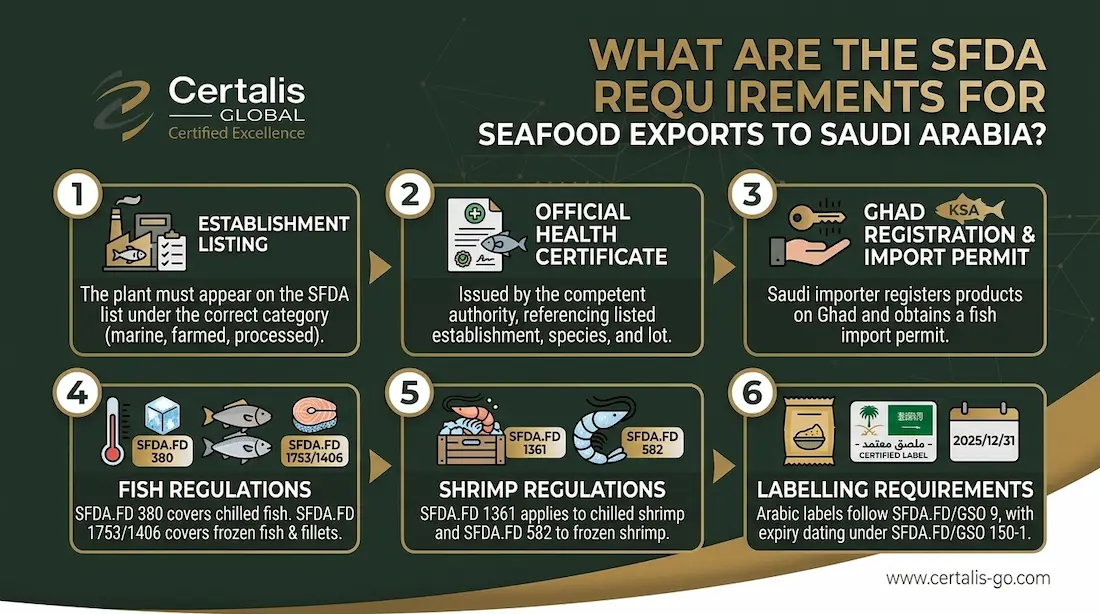
What are the SFDA requirements for seafood exports to Saudi Arabia?
SFDA applies establishment-based controls to fish, so seafood quality control and inspection must meet requirements that the Canadian Food Inspection Agency also lists for exporters.
- Establishment listing: the plant must appear on the SFDA list under the correct category for marine catch, farmed or processed products.
- Official health certificate: issued by the exporting country’s competent authority and referencing the listed establishment, species and lot.
- Ghad registration and import permit: the Saudi importer registers its products on Ghad and obtains a fish import permit.
- Fish regulations: SFDA.FD 380 covers chilled fish, SFDA.FD 1753 frozen fish and SFDA.FD 1406 frozen fillets.
- Shrimp regulations: SFDA.FD 1361 applies to chilled shrimp and SFDA.FD 582 to frozen shrimp.
- Labelling: Arabic labels follow SFDA.FD/GSO 9, with expiry dating under SFDA.FD/GSO 150-1.
Read More: Customs Clearance Process in Saudi Arabia Under FASAH Rules
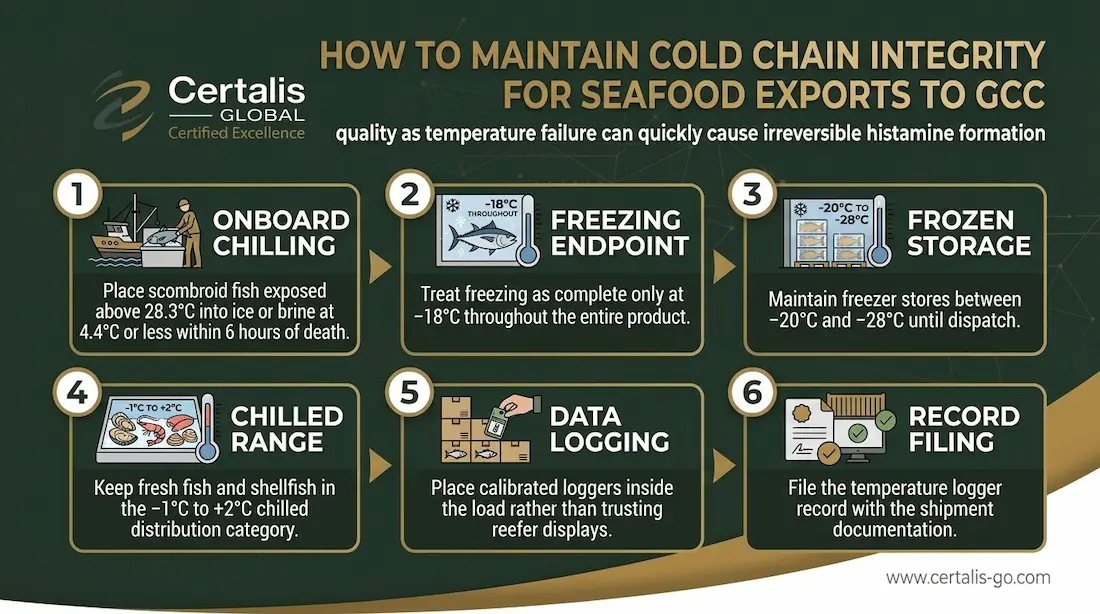
How to maintain cold chain integrity for seafood exports to GCC
Temperature failure can undo careful plant controls quickly, because histamine already formed in fish cannot be removed by later freezing or cooking.
- Onboard chilling: FDA guidance recommends placing scombroid fish exposed above 28.3°C into ice or brine at 4.4°C or less within 6 hours of death.
- Freezing endpoint: FAO guidance on frozen fish treats freezing as complete only at −18°C throughout the product.
- Frozen storage: freezer stores are held between −20°C and −28°C until dispatch.
- Chilled range: FAO guidance groups fresh fish and shellfish in the −1°C to +2°C chilled distribution category.
- Data logging: place calibrated loggers inside the load rather than trusting reefer displays, and file the record with the shipment.
What are the common causes of seafood rejection in Saudi ports?
Rejection risk usually clusters around preventable gaps in seafood quality control and inspection, and the areas below deserve the closest attention before loading.
- Mismatched establishments: the plant number on the health certificate is missing from the SFDA list or covers another species.
- Laboratory failures: histamine, microbiological counts or drug residues exceed the applicable Gulf limits.
- Labelling errors: missing Arabic text or expiry dates that do not follow SFDA.FD/GSO 150-1.
- Unsupported claims: halal or quality logos printed without supporting certificates.
- Temperature abuse: refrozen blocks, drip loss, freezer burn or logger gaps signalling a broken cold chain.
- Document mismatches: species, weights or lot numbers that differ between the certificate, invoice and cartons.
- Missing permits: consignments arriving before the importer secures the fish import permit.
Why Choose Certalis Global for Seafood Quality Control and Inspection?
Exporters work with Certalis Global because our seafood quality control and inspection support links product checks to the SFDA and Gulf requirements that decide clearance, backed by our expert Inspection and Certification Company.
- SFDA registration: preparing the technical files behind your importer’s product registration.
- Product classification: matching each product to its SFDA.FD and GSO technical regulations.
- Pre-shipment inspection: product checks completed before the container is sealed.
- Testing support: coordinating histamine, microbiological and residue analysis with laboratories using validated seafood testing equipment.
- HACCP certification support: helping plants build the hazard controls that Saudi importers and regulators expect.
Send us your species list and target ports, and we will propose a plan sized to your volume—simply reach out via our Contact Us page, WhatsApp, or certification@certalis-go.com.
FAQs
Is seafood inspection mandatory for exports to Saudi Arabia?
Yes, SFDA requires listed establishments, official health certificates and import permits, and it may sample any seafood consignment at the port.
What certificates are required for seafood exports to Saudi Arabia?
A health certificate, certificate of origin, invoice, bill of lading and import permit, plus a conformity certificate for some origins and proof of halal claims.
Does seafood exported to Saudi Arabia need Halal certification?
Plain fish usually does not, but a halal certificate is required when labels carry a halal claim or ingredients need halal certification.
How long does the seafood inspection process usually take?
Timing depends on how complete your documentation is, laboratory turnaround and whether SFDA withdraws samples for analysis at the port.
How is the cost of seafood inspection calculated?
Cost depends on lot size, sample numbers, test parameters, inspector travel and laboratory fees, while importers pay for any SFDA port analysis.