
A disciplined plan to test the quality of parts before shipment has become a commercial necessity rather than an optional extra for every manufacturer sending industrial components to the Gulf, because one defective batch can stall a container at the port, strain a buyer relationship and trigger costly re-certification, and this guide walks you through inspection types, testing parameters, a practical workflow, Saudi and GCC regulatory expectations and the most frequent rejection causes so your next consignment arrives ready for customs clearance.
What It Means to Test the Quality of Parts Before Shipment
Put simply, when buyers ask about the test the quality of parts before shipment meaning, they are referring to factory-level conformity checking, vital since a 2025 ASQ report found just 31% of respondents feel they fully understand quality costs.
- Verifying that dimensions, materials and finishes match approved drawings and specifications.
- Confirming that quantities, packing and markings align with the purchase order.
- Catching defects while rework is still affordable and the supplier remains accountable.
- Producing documented evidence that supports conformity certificates and customs files.
- Protecting the buyer’s production line from failures caused by faulty components.
Primary Types of Pre-Shipment Inspections for Industrial Parts
Exporters bound for Saudi Arabia need to test the quality of parts before shipment carefully, as GASTAT data shows machinery, electrical equipment and parts made up 31.5% of December 2025 imports.
- Initial production inspection, which checks raw materials and first-off samples before mass production begins.
- During production inspection, carried out mid-run to detect process drift before it spreads across the batch.
- Final random inspection, performed on finished and packed goods using statistical sampling to accept or reject the lot.
- Container loading supervision, confirming that the correct parts, quantities and packing are loaded and sealed.
- Laboratory testing, which sends samples for mechanical, chemical or electrical verification against standards.
- Factory audits, assessing the supplier’s quality system, equipment and traceability controls.
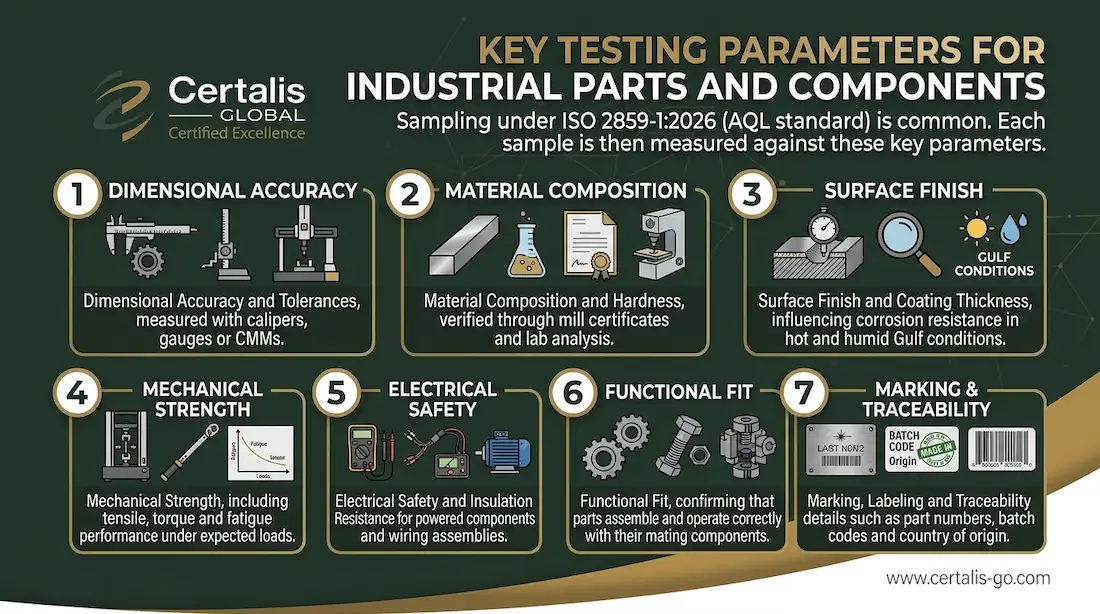
Key Testing Parameters for Industrial Parts and Components
Most teams test the quality of parts before shipment by sampling under ISO 2859-1:2026, the AQL standard published in January 2026, then measuring each sample against these parameters.
- Dimensional accuracy and tolerances, measured with calipers, gauges or coordinate measuring machines.
- Material composition and hardness, verified through mill certificates and laboratory analysis.
- Surface finish and coating thickness, which influence corrosion resistance in hot and humid Gulf conditions.
- Mechanical strength, including tensile, torque and fatigue performance under expected loads.
- Electrical safety and insulation resistance for powered components and wiring assemblies.
- Functional fit, confirming that parts assemble and operate correctly with their mating components.
- Marking, labeling and traceability details such as part numbers, batch codes and country of origin.
Read More: Saudi Arabia Import Document Requirements: A Complete Guide
Step-by-Step Parts Inspection Process
A repeatable workflow keeps results consistent, and businesses that test the quality of parts before shipment on every order tend to follow this sequence from booking to final report.
- Share specifications, drawings, approved samples and the purchase order with the inspector.
- Agree on the inspection level, AQL limits and defect classification before the visit.
- Inspect on site, drawing random samples from finished and packed lots.
- Run measurements, functional checks and any required laboratory tests.
- Record findings with photos and classify defects as critical, major or minor.
- Issue the report and decide whether to release, rework or reject the lot.
Secure Your Consignment with Comprehensive Product Inspection Services for Saudi Arabia
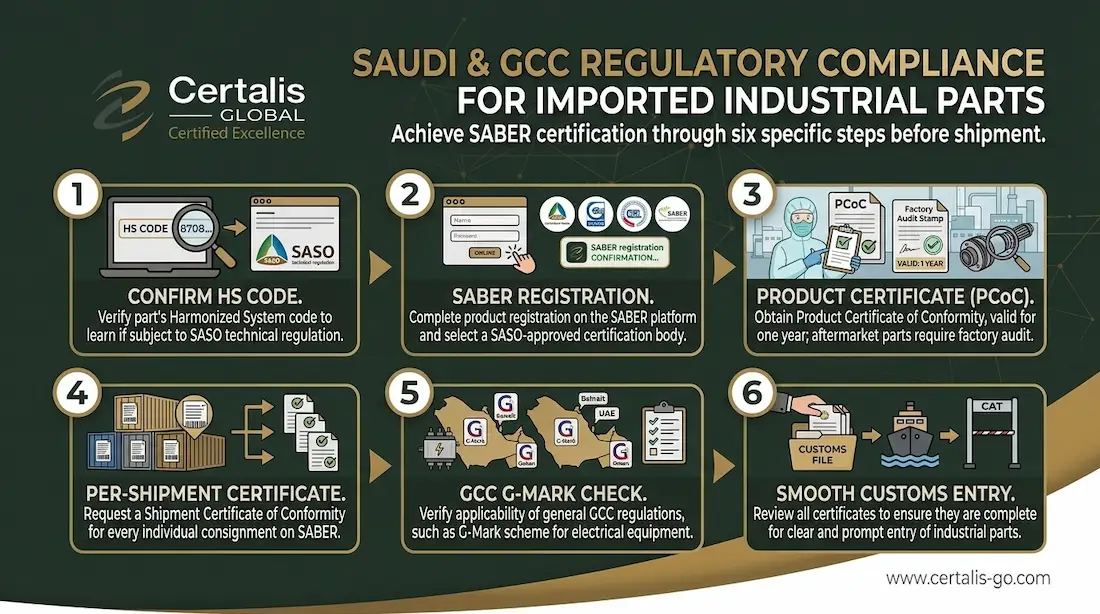
Saudi & GCC Regulatory Compliance for Imported Industrial Parts
Clearing a factory check is only half the journey, since the U.S. International Trade Administration notes that regulated products need two SABER certificates obtained before shipment.
- Confirm the HS code to learn whether the part falls under a SASO technical regulation.
- Register the product on SABER and select a SASO-approved certification body.
- Obtain the Product Certificate of Conformity, valid for one year, noting that aftermarket auto parts also require a factory audit.
- Request a Shipment Certificate of Conformity for every individual consignment.
- Check whether GSO technical regulations, such as the G-Mark scheme for low-voltage electrical equipment, apply to your parts across GCC markets.
Read More: Customs Clearance Process in Saudi Arabia Under FASAH Rules
Common Causes of Manufactured Parts Rejection at GCC Ports
Suppliers who test the quality of parts before shipment can head off many port rejections, because the issues below are easiest to fix while goods remain at the factory.
- Missing or expired Product Certificates of Conformity for regulated parts.
- Shipment certificates that do not match invoices, quantities or HS codes.
- Arabic or English labeling gaps, including absent manufacturer names or part numbers.
- Dimensional or material deviations from the declared technical specifications.
- Unverifiable branding or suspected counterfeits that raise intellectual property concerns.
- Damaged packaging or corrosion caused by poor protection during transit.
- Inconsistent country-of-origin declarations across commercial documents.
How Certalis Global Helps You Test the Quality of Parts Before Shipment
Manufacturers aiming to test the quality of parts before shipment with full regulatory confidence can rely on Certalis Global, which links inspection results to Saudi and GCC certification requirements, backed by our expert Inspection and Certification Company.
- Pre-shipment inspections tailored to your parts, drawings and contract terms.
- Coordination of laboratory testing against SASO, GSO and international standards.
- SABER registration support for Product and Shipment Certificates of Conformity.
- HS code classification checks that confirm which technical regulations apply.
- Document reviews that align invoices, labels and certificates before dispatch.
- Corrective action guidance when a lot fails, shortening the path to re-inspection.
Share your part specifications and destination market with the Certalis Global team, and our specialists will map out the inspections and certificates your next Gulf-bound consignment needs—reach out via our Contact Us page, WhatsApp, or certification@certalis-go.com.
FAQs
Is pre-shipment inspection mandatory for parts exported to Saudi Arabia?
Physical inspection is not universally mandated, but every shipment needs a SABER Shipment Certificate, and regulated parts also require a valid Product Certificate of Conformity.
What certificates are required to clear manufactured parts at Saudi ports?
Regulated parts need a Product Certificate of Conformity and a Shipment Certificate of Conformity through SABER, alongside the commercial invoice and certificate of origin.
Can businesses use their own internal inspectors for Saudi export compliance?
Internal inspectors can support quality control, but certificates for SASO-regulated parts must be issued by SASO-approved certification bodies through SABER.
What happens if parts fail the pre-shipment inspection?
The lot is held for rework, sorting or replacement and then re-inspected, since shipping nonconforming parts risks rejection at Saudi customs.
How long does a pre-shipment parts inspection usually take?
Timing depends on lot size and required tests, as visual and dimensional checks often finish within a day while laboratory testing can take longer.