



المدونة
Construction Products Certification for Gulf Exports

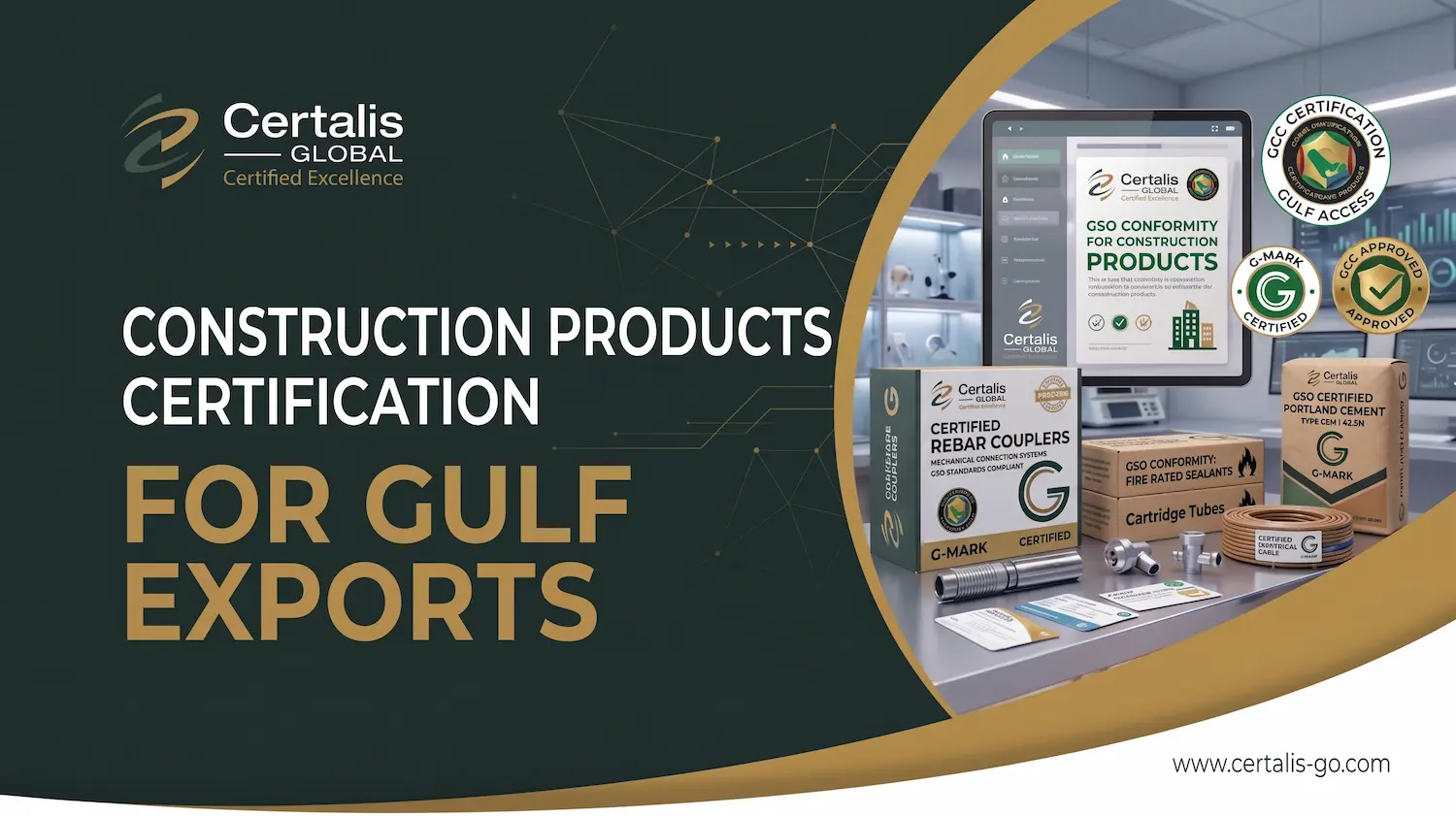
A steel beam, a bag of cement, and a box of ceramic tiles all face the same checkpoint at a border, since customs will not release any of them without proof that construction products certification has already taken place, and that single requirement decides whether a shipment reaches a job site on schedule or sits in a bonded warehouse racking up storage fees, so this guide sets out what the certification verifies, which certificate types exist, what paperwork a manufacturer must prepare, how Gulf rules layer onto international ones, and where Certalis Global fits into that sequence.
What Is Construction Products Certification?
Construction products certification is the formal confirmation that a building material or component meets defined safety, structural, and performance benchmarks before it enters a project, and this confirmation always comes from an accredited third party rather than from the manufacturer’s own quality team, which is precisely what gives the resulting certificate weight with engineers, regulators, and buyers who were not present for the original testing.
- Verifies structural strength, fire resistance, and durability against a recognized technical standard.
- Covers raw materials, prefabricated components, and fully finished building products alike.
- Produces a certificate or mark that engineers and customs officers can independently verify.
- Applies before the material is incorporated into any construction or infrastructure project.
Certalis Global, an expert Inspection and Certification Company, can confirm which certification path your specific material needs before a single sample ships out, sparing your team the guesswork of choosing a standard that a destination regulator will later reject.
Why Is Building Products Certification Important?
Construction products certification carries real consequences at the point of import, since an uncertified shipment can be delayed, quarantined, or turned away entirely, a risk regulators now take seriously given that more than 13,000 ASTM standards already govern safety and performance benchmarks for construction materials worldwide.
- Prevents customs holds on structural steel, cement, and other regulated categories.
- Shields contractors from liability should an uncertified material later cause a failure.
- Speeds project approvals since certified materials skip additional on-site testing.
- Opens access to public infrastructure tenders that frequently accept certified suppliers only.
We help exporters pinpoint exactly which building products certification a target market will enforce, well before materials are packed, so a shipment never becomes the test case for an unclear regulation.
Read More: Construction Products Testing for Gulf Compliance
Main Types of Certification for Construction Materials
Construction materials certification is never a single uniform stamp, since the correct pathway depends heavily on the material category and the regulatory framework governing the destination market, and confusing one certification type for another is one of the most common reasons a manufacturer ends up repeating work it thought was already finished.
- Type testing, where one representative sample batch is assessed against a technical standard.
- Factory production control, confirming that ongoing output still matches the tested sample.
- System certification, covering the manufacturer’s entire quality management process.
- Voluntary quality marks that signal performance well above the legal minimum requirement.
Certalis Global narrows this list down to the single certification type your material actually requires, instead of leaving a manufacturer to guess between overlapping frameworks on their own.
Read More: What Is a Product Lab Testing Service & How It Works
How to Get Construction Products Certification Step by Step
Construction products certification generally begins with sample submission and ends with a certificate tied to a specific product code, and the sequence rarely skips a stage no matter which market is involved, though the exact paperwork attached to each stage can shift depending on the technical regulation in force.
- A representative sample is drawn directly from production and sent to an accredited lab.
- Technicians measure the sample against every parameter set by the applicable standard.
- The certification body reviews the results once every threshold has been met.
- A certificate referencing the tested product code is issued and logged for verification.
Certalis Global manages sample logistics and laboratory liaison so this sequence never stalls at a single stage, keeping a production schedule intact while the paperwork catches up in parallel.
Read More: Saudi Arabia Import Document Requirements: A Complete Guide
Essential Documents Required to Certify Construction Materials
Construction products certification depends on a specific paper trail, and a single missing document is often enough to stall an otherwise fully compliant product.
- Technical data sheet describing the material’s composition and its intended use.
- Factory audit report confirming production conditions match the originally tested sample.
- Prior test reports issued by an accredited laboratory for the relevant standard.
- Signed declaration of performance or conformity from the manufacturer itself.
Our team checks this file against destination-market requirements before submission, never after a rejection notice arrives, since resubmitting a corrected file usually costs far more time than getting it right the first time.
Our Services: Secure Your Saudi Quality Mark (SQM) with Certalis Global
Middle East Construction Products Compliance: SASO and G Mark
Construction products certification across the Gulf splits into two distinct systems, since Saudi Arabia’s SASO governs building materials through its own national quality mark, while the shared G-Mark administered by GSO applies once a product is intended for sale across multiple Gulf states at once, and treating these two frameworks as interchangeable is a mistake that regularly costs exporters an extra certification cycle.
- SASO issues Saudi-specific certificates for materials entering the domestic market alone.
- The Saudi Quality Mark adds an optional or mandatory layer for select categories.
- GSO’s G-Mark applies to specific categories region-wide, such as low-voltage electrical building components, while structural materials like steel and cement strictly require the Saudi Quality Mark (SQM).
- A single material can require both SASO documentation and G-Mark depending on its buyers.
Certalis Global maps out whether SASO, G-Mark, or both apply to a material before you commit to one certification path, avoiding the expense of certifying twice because the wrong scheme was chosen first.
Why Choose Certalis Global for Construction Products Certification?
Regulations rarely stay still for long, and the European Union’s own Construction Products Regulation was rewritten in 2024, a reminder that even long-established markets keep revising their technical requirements without much notice.
Navigating changing technical regulations requires a dedicated Inspection and Certification Company, which is why Certalis Global monitors frameworks like the European Union’s updated Construction Products Regulation to ensure your already-certified products remain compliant.
- Direct coordination with accredited laboratories and certification bodies across regions.
- Ongoing monitoring of regulatory changes that could affect an already-certified product.
- Single point of contact handling documentation, testing, and renewal in one place.
- Clear timelines set upfront so a certification schedule never surprises a production plan.
Our specialists are ready to walk through your material’s certification requirements whenever you decide to start, mapping out realistic timelines before a single sample leaves the production line—simply reach out via our Contact Us page, WhatsApp, or info@certalis-go.com.
FAQs
Is it mandatory to certify construction materials?
For most regulated categories such as cement, steel, and electrical building components, certification is legally required before sale or import.
Who Needs to Certify Construction Products?
Manufacturers, importers, and distributors placing building materials on a regulated market all carry responsibility for securing certification.
How Does the Certification Process Differ From Laboratory Testing?
Lab testing only measures a sample’s performance against a standard, while certification is the formal, ongoing recognition issued once testing and factory audits both pass.
How long does the evaluation process take?
Timelines vary by material and market, though most construction product evaluations take between three and eight weeks from sample submission to final certificate issuance.

